
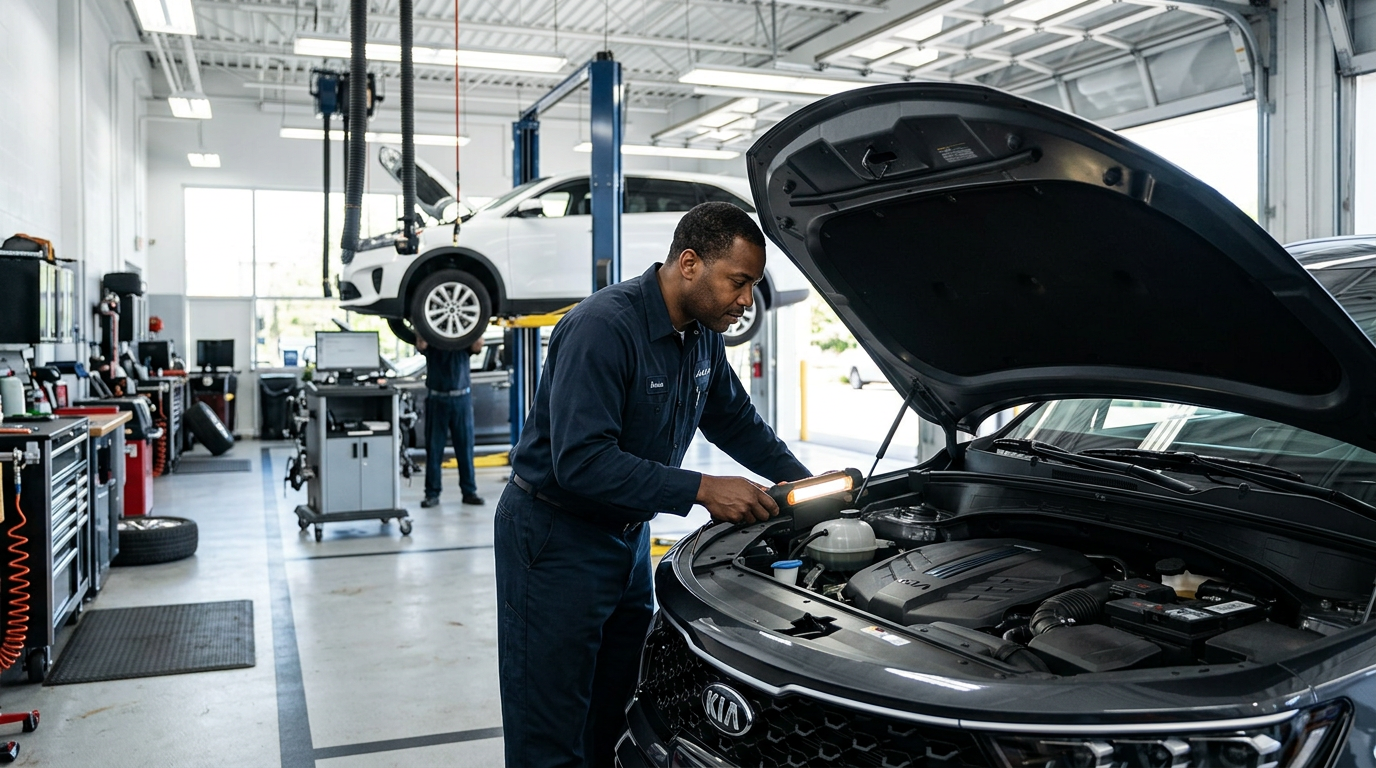
 What Routine Checks Are Included in a Standard Morristown Kia Maintenance Visit?
A standard Kia maintenance visit associates routine care with a 7,500-mile or 12-month interval that includes an engine oil and filter change, tire rotation, tire pressure adjustment, fluid level checks, and a comprehensive multi-point safety inspection. As a Service Director with over 10 years of experience managing vehicle care, I make sure our team follows factory guidelines on every vehicle that enters our bays. During this visit, technicians drain aged motor oil, install a fresh OEM filter, and inspect under-hood fluid levels—including engine coolant, brake fluid, windshield washer fluid, and power steering fluid when applicable—to confirm proper operating volume and clarity.
Tire care represents another foundational check during routine service. Our technicians measure tread depth across multiple grooves on each tire to catch uneven wear patterns early, while setting inflation pressures precisely to the specification listed on the driver’s door-jamb placard rather than the maximum pressure molded onto the tire sidewall. For drivers navigating the gently rolling hills and varied rural roads around Morristown, maintaining correct tire pressure and rotating tires every 7,500 miles ensures balanced traction and prevents premature tread cupping.
Operating conditions heavily dictate whether your vehicle requires standard or accelerated service timing. Kia guidelines recommend shortening oil change intervals to a 5,000-mile interval for vehicles exposed to severe driving conditions, such as frequent short trips under five miles, repeated cold-weather starts, extensive idling, commercial towing, or driving in mountainous terrain. If you ever have questions about which interval fits your daily driving habits, you can visit our Morristown service location or give our technicians a quick call at (423) 200-5335 for personalized guidance.
Table of Contents
- What Is Covered During a Comprehensive Kia Multi-Point Inspection?
- How Do Kia Service Technicians Inspect Brakes and Chassis Components?
- How Long Does an OEM Kia Battery Typically Last?
- What Factory Diagnostic Equipment Is Unique to Authorized Kia Service Centers?
- Are Kia Electric Vehicles Less Expensive to Maintain Than Traditional Gas Models?
What Is Covered During a Comprehensive Kia Multi-Point Inspection?
A comprehensive Kia multi-point inspection covers all primary mechanical, electrical, and safety systems, evaluating engine fluid clarity, battery health, brake pad thickness, tire tread wear, drive belts, cooling hoses, exterior lighting, wiper blades, and cabin air filters. This visual and physical evaluation acts as a health checkup for your vehicle, allowing factory-trained technicians to identify wear items before they turn into unexpected roadside breakdowns. Performing this check alongside routine oil changes gives owners a clear, ongoing record of their vehicle's condition.
To keep findings transparent, our service team utilizes a standardized color-coded reporting system during every multi-point check:
- Green: Indicates components in good operating condition that meet factory specifications and require no immediate attention.
- Yellow: Signals items showing moderate wear that should be monitored and planned for service in upcoming visits.
- Red: Identifies components with critical wear or damage requiring immediate repair or replacement to ensure vehicle safety.
Completing a standard multi-point check typically takes between 30 and 45 minutes when performed as part of a routine oil change visit. When drivers bring their vehicles in for major milestones, such as the 30,000-mile service, a common question I get is whether replacing the engine air filter and cabin air filter at the same time is truly necessary. Swapping out a clogged engine filter restores proper air intake for optimal fuel efficiency, while a fresh cabin filter protects interior air quality and reduces strain on your vehicle's HVAC blower motor. If your vehicle ever exhibits body alignment concerns or panel damage from a parking lot scrape, our team can coordinate with our certified body shop team to restore structural and aesthetic integrity.
How Do Kia Service Technicians Inspect Brakes and Chassis Components?
Kia service technicians inspect brake systems by measuring remaining brake pad thickness in millimeters with calibrated digital calipers, evaluating rotor faces for heat discoloration or surface grooves, checking hydraulic lines for leaks, and testing caliper piston movement. Maintaining precise pad measurements is critical for driver safety; new brake pads typically measure around 12 millimeters, while pads worn down to 3 millimeters or less require immediate replacement to prevent metal-on-metal contact with the rotor.
The chassis inspection extends to crucial underbody components that impact ride stability, steering control, and passenger comfort. Technicians examine front and rear suspension bushings, ball joints, steering gearboxes, tie-rod ends, sway bar links, and drive axle constant-velocity boots to verify rubber seals remain intact and free of cracks. Keeping constant-velocity boots sealed prevents road grit from entering the joint and grinding down internal bearings.
Did you know? Commuters embarking on the daily drive into Knoxville put significant demand on their vehicle's suspension and braking systems while navigating highway merging and stop-and-go traffic. Catching a torn rubber boot or worn sway bar bushing during routine chassis checks keeps steering precise and stops minor wear from turning into an expensive repair. Owners can stay proactive about vehicle health by scheduling a maintenance appointment online for their vehicle, including spacious family haulers like new Kia models with 3rd-row seating.
How Long Does an OEM Kia Battery Typically Last?
An OEM Kia 12-volt battery typically lasts between 3 and 5 years, depending on local climate conditions, driving frequency, and modern electronic accessory demands. Extreme summer heat often accelerates internal battery degradation faster than cold weather by evaporating internal electrolyte fluid and speeding up grid corrosion, while winter freezes place higher cranking demands on an already weakened battery.
During every routine maintenance visit, our technicians test battery health using an electronic conductance tester rather than relying on a simple voltage reading. Conductance testing measures the battery's cold-cranking amps and internal resistance, revealing how much starting power remains under load. Technicians also clean corrosion from battery terminals, inspect hold-down clamps for tightness, and verify that the alternator charging voltage meets factory output parameters.
Did you know? Modern Kia vehicles rely on complex electrical architectures to power advanced driver-assistance sensors, touchscreen displays, and keyless entry modules even while parked. If a battery drops below its ideal operating voltage, these sensitive electronic systems can exhibit glitchy behavior long before the engine struggles to turn over. Sourcing replacement batteries directly through our genuine Kia parts department guarantees exact cold-cranking amp ratings and proper casing dimensions engineered specifically for your vehicle.
What Factory Diagnostic Equipment Is Unique to Authorized Kia Service Centers?
Authorized Kia service centers utilize the proprietary Kia Diagnostic System (KDS), a specialized hardware and software suite designed specifically to interface with Kia vehicle electronics. Unlike aftermarket generic OBD-II scan tools that only read basic powertrain trouble codes, KDS connects directly to Kia factory servers to perform deep module scans, download current electronic control unit firmware updates, and execute component self-test protocols across every onboard computer.
Modern vehicles contain dozens of interconnected microprocessors managing everything from transmission shift timing and anti-lock braking logic to blind-spot detection radar calibration. KDS allows factory-certified technicians to perform essential recalibrations, carry out technical service bulleted updates, and access live sensor data streams that non-authorized facilities simply cannot reach with generic tools. This direct line to factory engineering software ensures electronic diagnosis is precise and completed according to exact manufacturer standards.
Are Kia Electric Vehicles Less Expensive to Maintain Than Traditional Gas Models?
Kia electric vehicles can cost less to maintain over time compared to traditional internal combustion engine models because EV architecture eliminates high-wear mechanical components like engine oil, spark plugs, timing belts, fuel filters, exhaust systems, and complex multi-speed automatic transmissions. Without combustion byproducts or thermal engine oil degradation, routine EV maintenance visits focus primarily on chassis care, cabin air filtration, and electronic system diagnostics.
While electric vehicles reduce traditional fluid and filter service, specialized maintenance remains essential to protect long-term vehicle performance. High-voltage cooling systems require specific low-conductivity coolant flushes at manufacturer-specified intervals to maintain optimal operating temperatures for the lithium-ion battery pack. Additionally, because electric powertrains deliver instant torque to the drive wheels, regular tire rotations and alignment checks are critical to ensure uniform tire wear across all four wheels.
Electrified models benefit from comprehensive factory coverage, including a dedicated 10-year/100,000-mile EV/Hybrid System Warranty that protects high-voltage batteries, drive motors, and power control units. Drivers exploring electrified options can visit our service center location, explore new Kia hybrid and electrified inventory, or reach our certified service team by giving us a phone call to keep their vehicle operating efficiently for years to come.
© 2026 Rusty Wallace Kia Morristown. All rights reserved.