

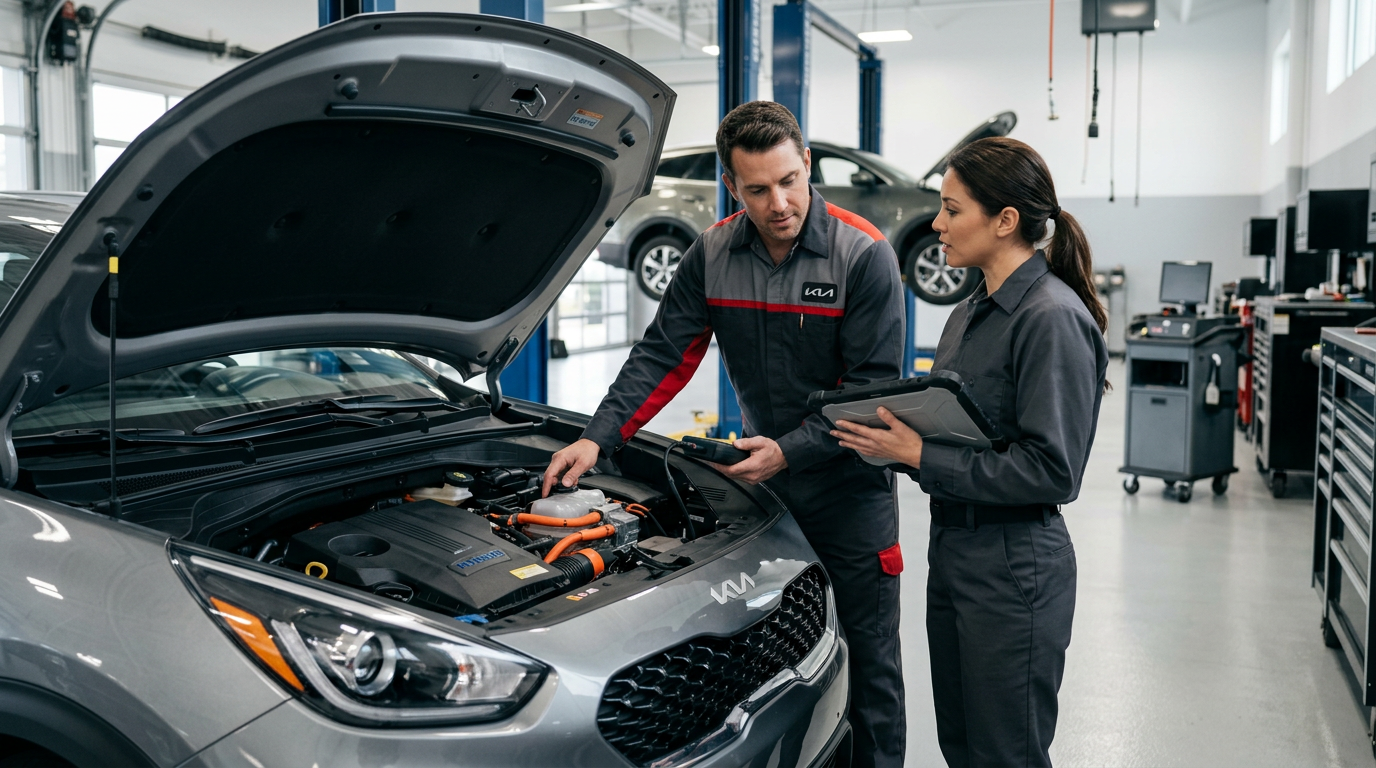
 Kia Hybrid Battery and Maintenance Questions: A Q&A With Our Service Team
Authorized Kia dealerships replace the high-voltage hybrid battery as a complete, OEM-approved assembly rather than swapping individual cells or modules, ensuring full system balance and strict safety compliance. We sat down with our Service Director at Rusty Wallace Kia Morristown to answer common questions regarding Kia hybrid battery longevity, diagnostic warning signs, warranty terms, and routine maintenance schedules.
Can Individual Modules or Cells Be Replaced in a Kia Hybrid Battery Pack?
Q: Can individual modules or cells be replaced in a Kia hybrid battery pack?
A: Authorized Kia dealerships install a complete, OEM-approved high-voltage battery assembly rather than replacing single cells or internal modules. While aftermarket repair shops sometimes attempt individual cell swaps, Kia engineers design the high-voltage lithium-ion polymer pack to operate as a unified energy system. Replacing an isolated module leaves older, worn cells alongside a fresh one, which creates voltage imbalances, accelerates thermal degradation, and risks premature pack shutdown.
In our workshop, high-voltage battery service focuses on exact factory diagnostics and total system safety. The high-voltage battery pack in models like the 2026 Kia Niro Hybrid relies on sophisticated battery control management units to regulate cell balancing, temperature, and current flow. When diagnostic codes indicate internal battery failure, installing a complete OEM battery assembly ensures every cell shares identical internal resistance, capacity, and thermal characteristics.
For drivers navigating the hilly Ridge-and-Valley Appalachian terrain around Panther Creek State Park, maintaining precise battery voltage balance is essential for dependable power delivery. If you suspect a traction battery concern, you can reach our service advisors at (423) 200-5335 or confirm our Morristown service center address to set up a comprehensive battery health assessment.
Table of Contents
- What Are the Early Warning Signs That a Kia Hybrid Battery Is Degrading?
- How Long Does a Kia High-Voltage Hybrid Battery Typically Last?
- How Does Kia's Hybrid Warranty Compare to Toyota's Hybrid Battery Coverage?
- Are Oil Change Intervals Different for Kia Hybrid Vehicles?
- What Routine Maintenance Does a Kia Hybrid Still Need and Where Is It Confirmed?
- Can You Drive a Kia Plug-in Hybrid If the Battery Is Fully Depleted?
What Are the Early Warning Signs That a Kia Hybrid Battery Is Degrading?
Q: What are the early warning signs that a Kia hybrid battery is degrading?
A: Sudden drops in fuel efficiency, rapid state-of-charge gauge fluctuations, and a combustion engine that runs continuously are the primary indicators of high-voltage hybrid battery degradation. When internal battery capacity declines, the hybrid system can no longer store sufficient electrical energy during regenerative braking. Consequently, the 1.6L gasoline engine must engage more frequently to power the vehicle and maintain high-voltage reserve levels.
Drivers should also monitor dashboard status indicators, such as a persistent master warning light or a "Check Hybrid System" notification. If the hybrid battery cooling fan behind the rear seats runs at maximum speed continuously, the control module is attempting to lower excessive internal pack temperatures caused by rising electrical resistance.
Addressing potential battery issues early prevents unnecessary strain on secondary hybrid components, including the starter-generator and power control unit. Should you notice unusual hybrid performance while browsing our new Kia hybrid inventory or servicing your current vehicle, our factory-trained technicians utilize specialized Kia diagnostic equipment to measure precise battery state-of-health. We also stock original equipment components through our genuine Kia parts department to handle all routine hybrid cooling maintenance and system repairs.
â
How Long Does a Kia High-Voltage Hybrid Battery Typically Last?
Q: How long does a Kia high-voltage hybrid battery typically last?
A: A high-voltage Kia hybrid battery is engineered to last the operating lifespan of the vehicle, typically delivering 10 to 15 years or well over 150,000 miles under normal driving conditions. Advanced lithium-ion polymer chemistry provides higher energy density and superior thermal resistance compared to older nickel-metal hydride battery designs, allowing models like the 2026 Kia Sportage Hybrid to retain strong energy retention across years of service.
The overall longevity of a hybrid battery relies heavily on effective thermal management and consistent driving habits. Extreme ambient temperatures and prolonged periods of vehicle inactivity represent the two primary factors that accelerate chemical battery aging. Daily driving naturally cycles the battery within its optimal state-of-charge band, which prevents capacity breakdown.
"A high-voltage hybrid battery is engineered to last the operating lifespan of the vehicle, typically delivering 10 to 15 years or well over 150,000 miles under normal driving conditions."
Routine checks of the battery cooling intake duct ensure unobstructed airflow to the internal pack. When proper maintenance practices are followed, most owners drive their hybrid vehicles for well over a decade without ever requiring a high-voltage battery replacement.
â
How Does Kia's Hybrid Warranty Compare to Toyota's Hybrid Battery Coverage?
Q: How does Kia's hybrid warranty compare to Toyota's hybrid battery coverage?
A: Original owners of a new Kia hybrid receive a 10-year/100,000-mile hybrid system warranty covering the high-voltage battery, hybrid starter-generator, and power control unit. By comparison, Toyota provides a 10-year/150,000-mile hybrid battery warranty standard across all subsequent owners. While Toyota extends mileage limits for secondary owners, Kia matches the 10-year duration and pairs it with broader overall vehicle protection for the initial buyer.
Kia backs its hybrid vehicles with a 5-year/60,000-mile basic limited warranty and 5-year/60,000-mile roadside assistance, whereas Toyota offers a shorter 3-year/36,000-mile basic warranty term. For original buyers, Kia's combined 10-year/100,000-mile powertrain and hybrid component coverage provides long-term warranty coverage for major mechanical assemblies.
For buyers considering a Certified Pre-Owned Kia hybrid, the full 10-year/100,000-mile powertrain warranty is restored from the original in-service date. This protection gives pre-owned hybrid buyers the exact same long-term coverage peace of mind enjoyed by original vehicle owners.
â
Are Oil Change Intervals Different for Kia Hybrid Vehicles?
Q: Are oil change intervals different for Kia hybrid vehicles?
A: Kia hybrid vehicles require synthetic engine oil changes every 7,500 miles or 12 months under normal driving conditions, matching the standard schedule of non-hybrid gasoline models. Even though the internal combustion engine turns off periodically during low-speed electric cruising, engine oil still experiences thermal cycling and moisture accumulation that require regular service intervals.
During winter months in East Tennessee, short suburban trips can prevent the 2.5L engine in a 2026 Kia Sorento Hybrid from reaching full operating temperature. This operational pattern can allow unburned fuel and water vapor to collect in the oil pan, making calendar-based oil changes essential regardless of total accumulated mileage.
Maintaining fresh synthetic oil protects internal engine bearings and variable valve timing actuators from premature wear. When you are ready for routine vehicle maintenance, our certified technicians make scheduling your maintenance online quick and convenient. Whether you drive a compact hybrid or are cross-shopping new Kia vehicles with third-row seating, adhering to factory service intervals guarantees maximum engine efficiency and protects your factory warranty.
â
What Routine Maintenance Does a Kia Hybrid Still Need and Where Is It Confirmed?
Q: What routine maintenance does a Kia hybrid still need and where is it confirmed?
A: Routine maintenance for Kia hybrids includes scheduled oil changes, air filter replacements, brake fluid flushes, coolant servicing, and tire rotations to ensure optimal performance. While regenerative braking reduces physical friction wear on brake pads and rotors, the mechanical brake calipers require periodic inspection and lubrication to prevent binding caused by road salt and moisture.
Hybrid powertrains also rely on dedicated cooling loops to manage electrical temperatures across the inverter and high-voltage battery. The engine coolant and specialized high-voltage inverter coolant must be inspected during routine service visits and replaced according to factory schedule guidelines. Clean air filters are equally critical, as restricted cabin air filters can starve the hybrid battery cooling duct of adequate airflow.
Owners should always confirm exact service intervals by consulting the maintenance section of their official Kia owner's manual. Because service requirements vary based on powertrain configuration and driving environment, following the model-specific factory manual prevents missed service items and protects overall vehicle health.
â
Can You Drive a Kia Plug-in Hybrid If the Battery Is Fully Depleted?
Q: Can you drive a Kia Plug-in Hybrid if the battery is fully depleted?
A: You can continue driving a Kia Plug-in Hybrid indefinitely when the pure electric driving range reaches zero miles. When electric energy reserve depletes, the hybrid control system automatically transitions the vehicle into conventional hybrid operating mode. The gasoline engine starts smoothly to power the vehicle while regenerative braking captures decelerating kinetic energy to maintain a baseline battery charge.
On regular daily commutes along the busy urban corridors around Knoxville, a Kia Plug-in Hybrid operates seamlessly between electric mode and gasoline-hybrid power. The vehicle reserves a hard electrical buffer at the bottom of the battery capacity scale, ensuring full acceleration power from the electric drive motor is always available when passing or climbing steep highway grades.
Maintaining your plug-in hybrid involves regular engine maintenance alongside high-voltage system checks. If you ever have questions regarding hybrid operation or require technical assistance, you can view driving directions to our service center or speak directly with our certified technical team at (423) 200-5335 to keep your Kia running at peak efficiency.
© 2026 Rusty Wallace Kia Morristown. All rights reserved.
Categories:
Ownership & Service