

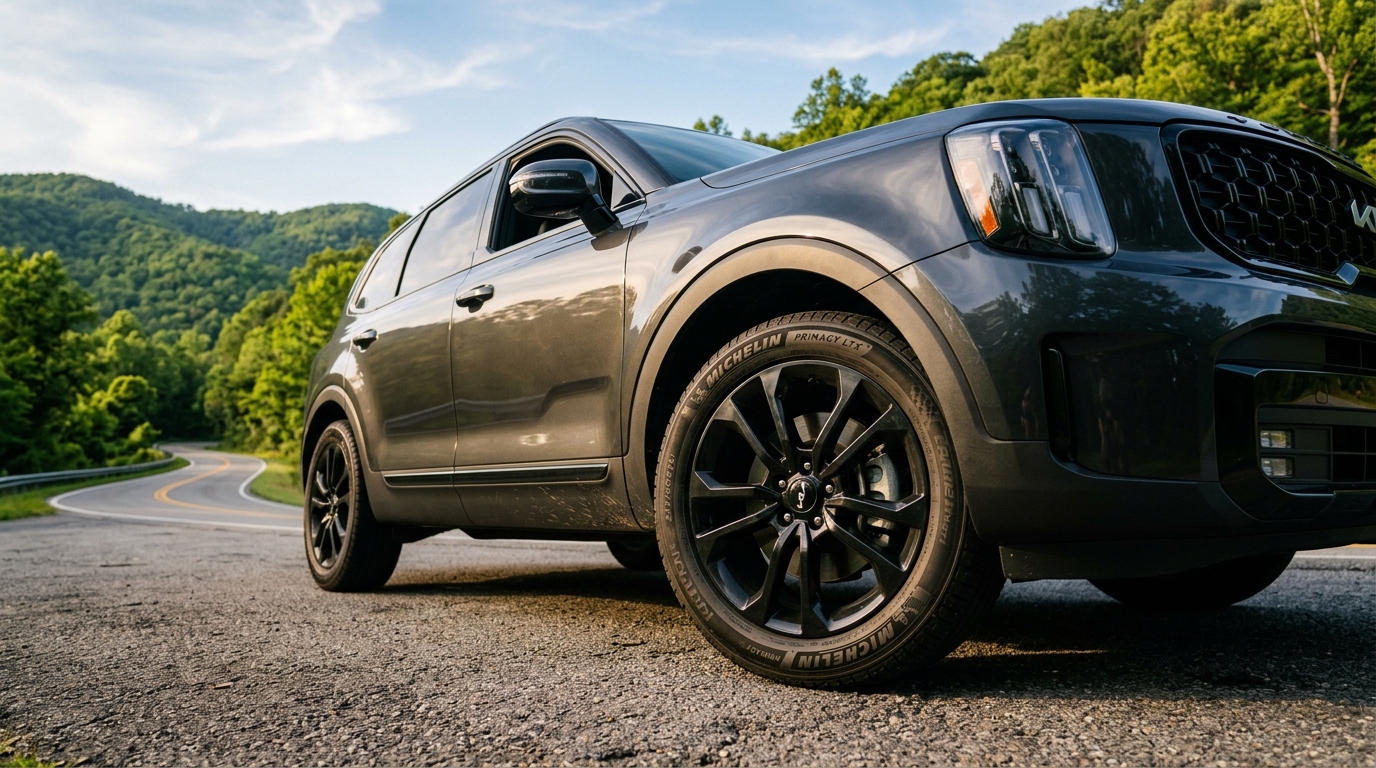
A standalone tire rotation at a Kia dealership typically costs between $25 and $50, though promotional offers frequently bring standalone service pricing lower, while bundled maintenance packages including an engine oil change and multi-point inspection range from $70 to $130. To help East Tennessee drivers protect their vehicles, our Service Manager at Rusty Wallace Kia Morristown, who brings over a decade of hands-on technical experience, sat down with us to break down tire maintenance schedules, rotation patterns, and long-term ownership savings.
Q: How much does a basic tire rotation cost at a Kia dealership?
A: Standard menu pricing for a standalone tire rotation at a franchised Kia dealership usually falls between $25 and $50. However, many dealerships run periodic maintenance specials that offer standalone rotations priced lower. For most vehicle owners, the most cost-effective approach is bundling the tire rotation into scheduled maintenance visits. Combining an engine oil change, oil filter replacement, tire rotation, and comprehensive multi-point inspection typically runs between $70 and $130 total, depending on whether your vehicle requires synthetic oil and the specific wheel size involved.
The exact service cost can vary based on wheel geometry and specialized equipment requirements. Vehicles equipped with larger 19-inch or 20-inch alloy wheels, low-profile tires, or directional tread patterns require extra technician time during dismounting and balancing. Furthermore, modern Kia models utilize direct Tire Pressure Monitoring Systems, meaning our certified technicians perform a TPMS sensor reset to ensure the dashboard accurately reflects each tire's physical location on the vehicle. Drivers can visit our Morristown service center location or contact our service advisors directly at (423) 200-5335 to confirm current service pricing and available maintenance specials.
Q: What mileage interval is recommended for rotating tires on a Kia?
A: Kia recommends rotating tires every 5,000 to 7,500 miles or every six to twelve months, depending on driving habits and model specifications. For standard gasoline vehicles, this interval lines up perfectly with factory-scheduled oil change appointments. Adhering to this timeframe prevents initial shoulder wear from developing into permanent tread cupping or diagonal scrubbing across the tread blocks.
Navigating the steep elevation changes and rolling hills throughout Morristown places heightened friction loads on front tires during steering and braking maneuvers. Front tires absorb up to two-thirds of total braking force while simultaneously delivering steering inputs, causing their outer shoulder ribs to degrade up to twice as fast as the rear tires. Moving wheels between front and rear axles at regular intervals balances out these mechanical stresses and maintains consistent contact patch geometry.
Owners operating high-efficiency models, including our new hybrid lineup, should follow these mileage benchmarks closely to preserve low rolling resistance. Choosing factory-approved components through our genuine parts department ensures your replacement tires and maintenance parts meet exact manufacturer standards for durability, traction, and ride comfort.
Q: How do all-wheel drive systems and electric motors change tire rotation schedules?
A: All-wheel drive vehicles and electric vehicles require tighter tire rotation schedules, typically every 3,000 to 5,000 miles, due to continuous torque delivery and heavier curb weights. On all-wheel drive models like the Sorento or Telluride, an electro-hydraulic center coupling continuously distributes power between the front and rear axles. If uneven tread wear causes tread depth to vary by more than 2/32 of an inch between tires, the resulting difference in rotational speed puts constant strain on internal differential gears, generating excessive friction heat that can damage sensitive transfer case components.
"Keeping your tread depth matched across all four wheels is the single simplest way to prevent multi-thousand-dollar differential damage on an all-wheel drive SUV."
Electric vehicles like the EV6 and EV9 present distinct tire wear dynamics due to instant electric motor torque and heavy floor-mounted battery packs. High motor torque creates strong rotational shear forces at the tire contact patch during acceleration, accelerating center-tread wear. Drivers who notice vibration alongside irregular tread wear after striking deep road hazards can rely on our collision repair center for frame and wheel alignment restoration, while visitors interested in our facility's history can learn more about our commitment to customer care.
Q: How do you check Kia tire tread depth using a coin test and spot early wear?
A: You can quickly check tire tread depth by inserting a standard U.S. penny head-first into the deepest tread groove with Abraham Lincoln's head facing down toward the tire casing. If the top of Lincoln's head remains entirely visible above the tread block, your tread depth has worn down to or below 2/32 of an inch, meaning the tire is legally worn out and must be replaced immediately. Performing this test across the inner, center, and outer tread ribs helps reveal subtle alignment and inflation issues before they cause catastrophic tire failure.
Catching uneven wear patterns early allows technicians to correct suspension misalignments or improper inflation pressures before destroying the tire casing. Outer shoulder wear typically points to excessive hard cornering or misaligned front camber, whereas wear concentrated along both outer edges simultaneously indicates persistent under-inflation. Center-tread wear signals over-inflation, and scalloped or cupped dips around the tread edge point to worn shock absorbers or unbalanced wheel assemblies.
For wet-weather driving along busy commuter corridors in Knoxville, replacing tires when they reach 4/32 of an inch of remaining tread depth provides crucial protection against hydroplaning. At 4/32 of an inch, a tire's ability to channel standing water away from the contact patch drops significantly, extending stopping distances on rain-slick highway pavement. Checking your tires monthly with a coin or digital gauge guarantees predictable braking response when severe weather strikes.
Q: What long-term tire cost savings can Kia owners expect from regular rotations?
A: Regular tire rotations can extend total tread life by up to 20,000 miles, allowing vehicle owners to delay purchasing expensive replacement sets and save hundreds of dollars over the vehicle's lifespan. A premium set of replacement tires represents a significant financial investment. By investing roughly $25 every 7,500 miles to rotate physical axle positions, drivers ensure all four tires wear down symmetrically down to their treadwear indicators rather than discarding front tires prematurely at half their potential mileage.
Consistent tire rotations also preserve peak fuel efficiency and reduce strain on steering and suspension components. Unevenly worn tires create high rolling resistance, forcing the engine or electric motor to consume extra energy to maintain steady cruising speeds on open highways. Furthermore, uneven tread faces generate severe cabin road noise and erratic tracking that subjects tie-rod ends, wheel bearings, and control arm bushings to unnecessary mechanical vibration.
Documenting routine rotations is equally essential for preserving warranty protections. Major tire manufacturers mandate documented rotation receipts at strict mileage intervals to honor treadwear mileage warranties. Skipping scheduled rotations invalidates manufacturer mileage guarantees, leaving owners fully responsible for premature tread degradation costs.
Q: Are original factory tires covered by warranty, and does independent service void coverage?
A: Original equipment tires installed on new Kia vehicles are covered under a separate warranty provided directly by the individual tire manufacturer rather than Kia Motors. Coverage details regarding treadwear, workmanship, and material defects vary depending on whether your vehicle came equipped with Michelin, Continental, Goodyear, Hankook, or Kumho rubber. Maintaining detailed service records showing regular rotations is essential if you ever need to file a warranty claim for premature tread degradation with the tire maker.
Getting routine tire service at an independent repair shop does not void your vehicle's factory warranty. Under the federal Magnuson-Moss Warranty Act, vehicle manufacturers cannot invalidate warranty coverage simply because maintenance was performed at a non-dealership facility, provided the required service was executed correctly. Vehicle owners must simply keep complete, dated service invoices showing that rotations were performed at recommended mileage intervals.
However, having service completed at a certified dealership offers distinct technical advantages. Independent facilities frequently use uncalibrated pneumatic impact wrenches that can stretch wheel studs or warp brake rotors by over-tightening lug nuts. Dealership technicians utilize calibrated torque wrenches set to exact factory specifications between 79 and 94 lb-ft, ensuring proper wheel hub seating without risking brake component distortion.
Q: Why choose certified tire care and OEM maintenance at Rusty Wallace Kia Morristown?
A: Choosing certified service ensures your vehicle is cared for by factory-trained technicians using specialized diagnostic tools, model-specific lifting protocols, and original equipment components. Our service department follows strict hoist positioning standards to protect reinforced frame points and underbody battery trays from damage during elevation. Furthermore, every tire service includes precision electronic TPMS sensor recalibration so your instrument cluster displays accurate pressure information for each tire location.
Bundling your routine tire rotations with factory maintenance visits gives you complete confidence on every drive. Our technicians inspect brake pad thickness, rotor surfaces, suspension bushings, and CV axle boots while your wheels are removed, catching minor wear items long before they turn into costly mechanical repairs. Combined with competitive menu pricing and transparent customer service, certified care keeps your vehicle operating safely and efficiently across East Tennessee.
To maintain your vehicle's safety, efficiency, and long-term resale value, visit our Morristown showroom and service drive today. You can speak directly with our service team by calling (423) 200-5335 or conveniently reserve your next maintenance appointment by scheduling your next service appointment online.
© 2026 Rusty Wallace Kia Morristown. All rights reserved.
Categories:
Service